Digital Terraforming
An M+ commission by Guo Cheng that pinches the Earth along the path of a single click — I built the web side
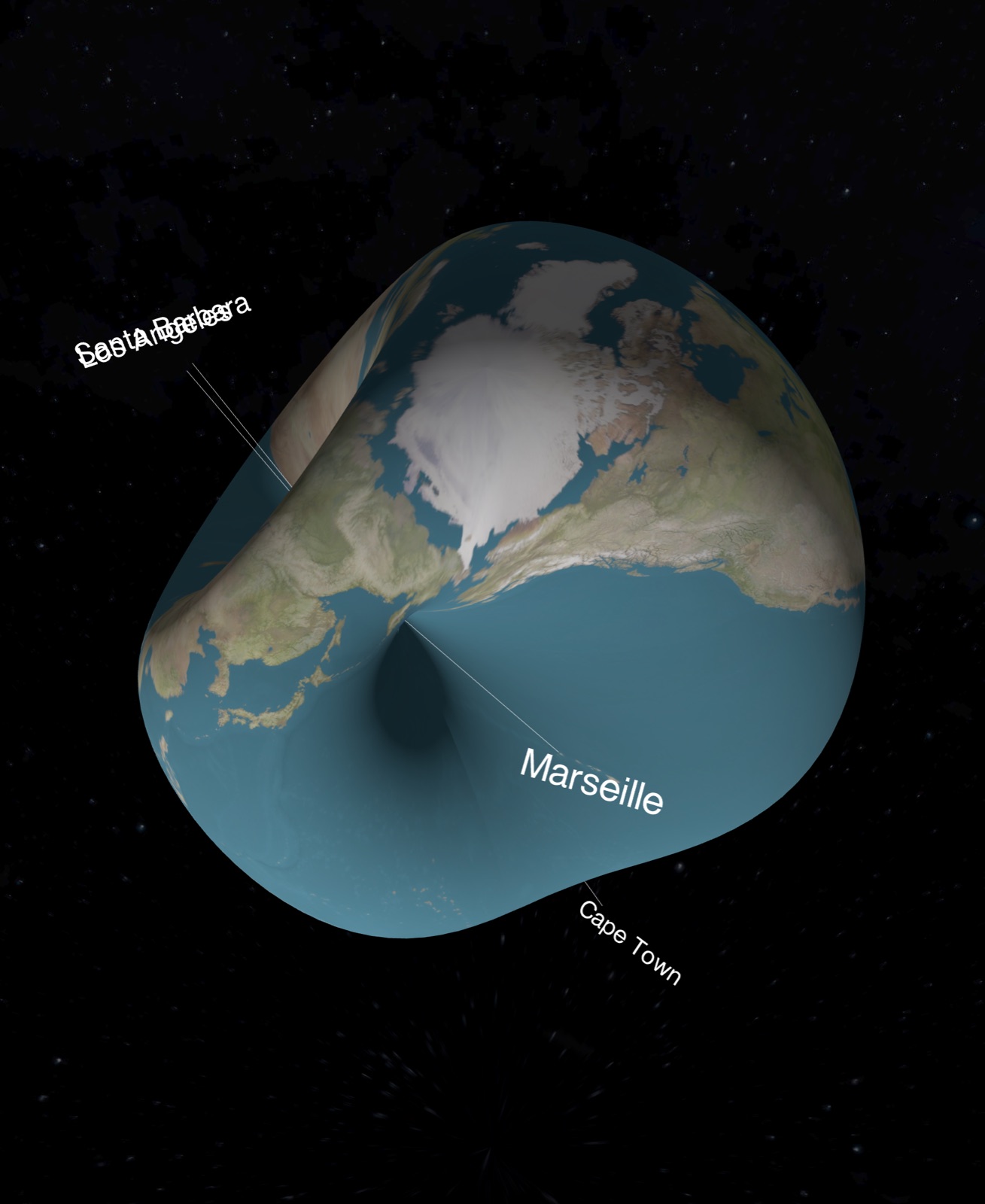
How is a single mouse click on a webpage button experienced in the physical world? A click’s data leaps through several servers in different places, each with its own IP address, in a few milliseconds. Digital Terraforming takes those locations and pinches the Earth at each of them, collapsing them toward a single point inside the globe — a shape that stands for the compression of time and space that a click actually performs.
Open the piece and it does this with your own connection. The planet you get is the shape of your route.
Before you press the button
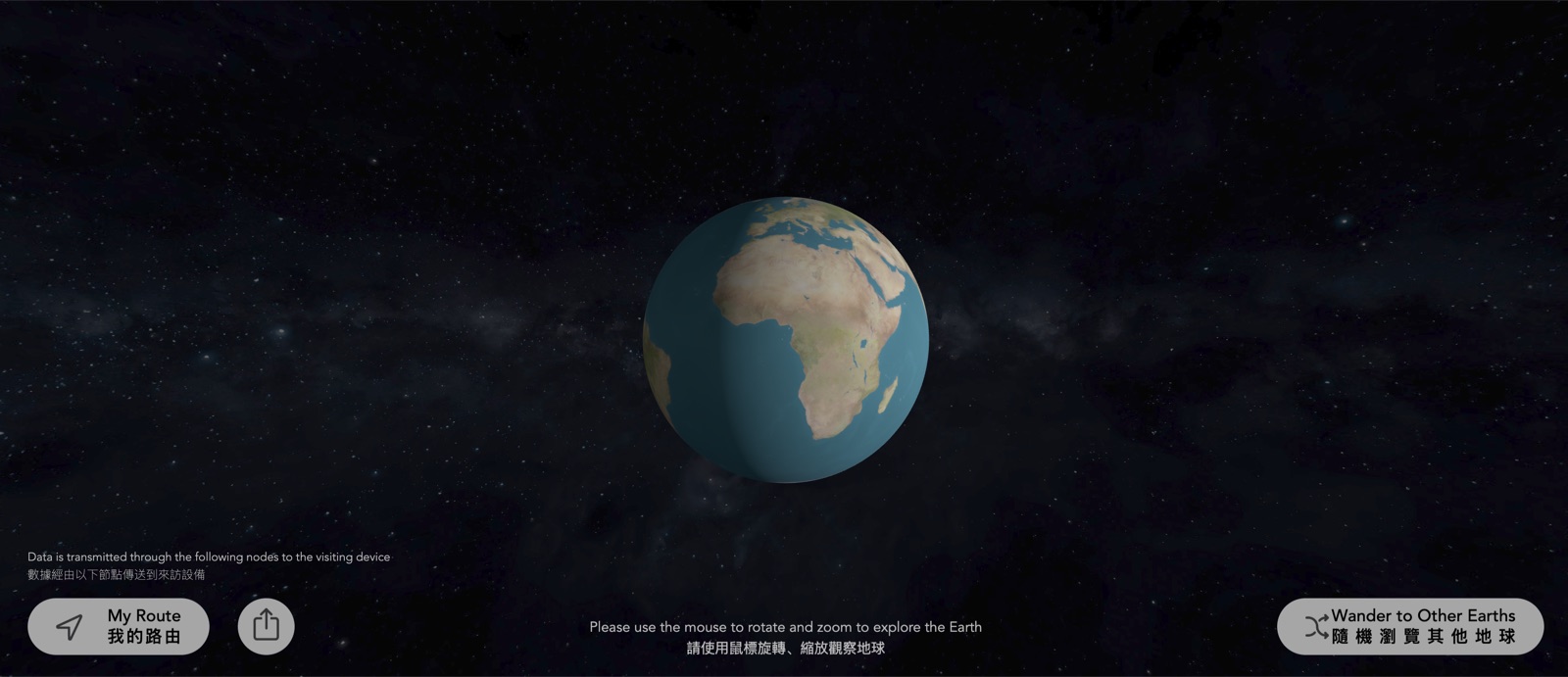
It starts intact — a normal planet, and an invitation.
The route, listed and drawn
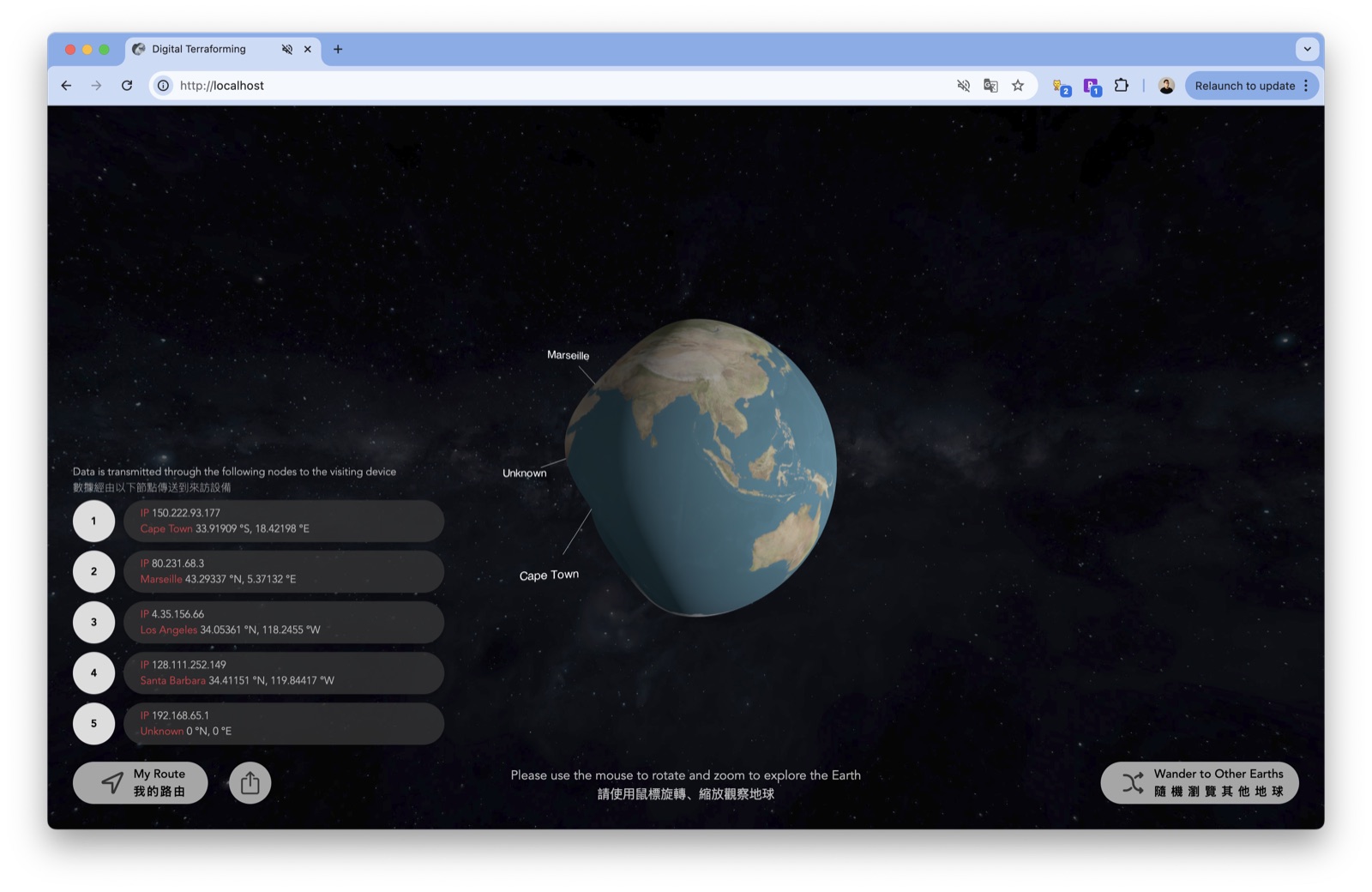
The hops appear as a numbered list — IP, resolved city, latitude and longitude — and simultaneously as labels on the deformed globe, so the abstract list and the shape it produced stay in one view. Some hops never resolve; those come back as Unknown, 0°N 0°E, which is its own kind of honesty about how much of the network declines to say where it is.
Inside, the cables
The deformation is not the end of it. The globe opens onto the map of undersea cables — a network begun in the 1850s and now lying across the seabed — which is the infrastructure a click actually travels on and the part nobody ever sees. That is the point the piece is making: the network is not abstract, it is cable, in particular oceans, laid by particular people, and it has been there longer than most of what runs over it.
Each visit’s globe can be downloaded, and Wander to Other Earths pulls a stored one at random, so the work accumulates an archive of planets. No personal information is kept.
Credits
- Artist — Guo Cheng
- UI Design — Chen Yiyun
- Web Developer — Weihao Qiu
- Sound Design — Zerui Quan
Commissioned by M+, Hong Kong, as an M+ Digital Commission. Online from 28 January 2025.